---
title: "Why Men Take Higher Occupational Risks: Biological and Cultural Factors"
description: Men account for 95–96% of workplace fatalities. Explore the biological, cultural, and occupational factors behind male risk-taking and what it means for workplace safety.
image: https://blog.mancounsellor.com.au/hubfs/Workplace%20Risks.png
---
# Why Men Take Higher Occupational Risks: Biological and Cultural Factors
Across Australia and much of the world, men make up the overwhelming majority of workers in dangerous occupations and workplace fatalities.
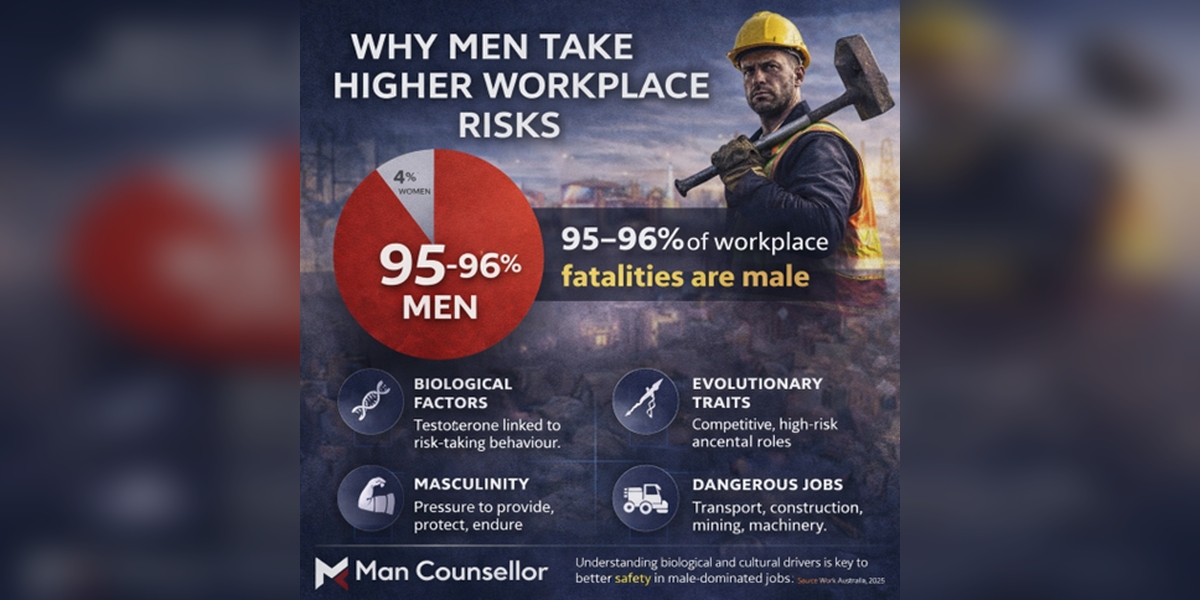
According to Safe Work Australia, approximately 95–96% of workers who die from traumatic workplace injuries are male. These deaths occur predominantly in industries such as agriculture, construction, transport, mining, and heavy machinery operation.
Understanding why men take higher occupational risks requires examining biological, psychological, and cultural influences.
Biological influences
Research in behavioural science shows that, on average, men display higher levels of risk-taking behaviour. One biological factor often discussed is testosterone, which is associated with competitiveness, sensation-seeking, and reward-driven behaviour.
Apicella et al. (2008) found links between testosterone levels and greater tolerance for risk in decision-making contexts.
Evolutionary influences
Evolutionary psychology suggests that historically male roles often involved hunting, defence, exploration, and protection. These activities required higher risk tolerance and rapid responses to physical threats.
Wilson and Daly (1985) described this tendency as the “young male syndrome,” referring to higher levels of competitiveness and risk-taking among males.
Cultural expectations
Cultural expectations also shape occupational choices. In many societies men are still expected to take on roles involving physical labour, infrastructure building, transport, emergency response, and defence.
These occupations carry higher risk but are also linked to social expectations of providing and protecting.
Occupational distribution
Another major factor is labour market segregation. Male-dominated industries tend to involve physical labour, machinery, outdoor environments, and transport logistics. Female-dominated industries tend to be concentrated in education, healthcare, administration, and service sectors that generally involve lower fatal injury risk.
Workplace culture
Some high-risk industries historically developed cultures that reward toughness and discourage reporting hazards. Modern safety programs increasingly focus on changing these norms.
Understanding the drivers of risk-taking helps design better safety systems, training, and workplace policies that reduce fatalities.
References:
Apicella, C. et al. (2008). Testosterone and financial risk preferences. Evolution and Human Behavior.
Wilson, M. & Daly, M. (1985). Competitiveness, risk-taking and violence: The young male syndrome.
Safe Work Australia. Key Work Health
[ ](https://blog.mancounsellor.com.au/hs/cta/wi/redirect?encryptedPayload=AVxigLJFkL%2Fc8C2MdbcoIjm1NwKM9yXPZ0zRdc%2FyNM%2BptNNg5fuhLe1c79GSTQqncIS9l38KC6yFY%2B89gNuPhOHKRe%2BqHhV%2B9elW2bupV2yXRRJrBiYZD10wso3O8xIYVPNM3nDlilaMLFXXrFsBd1BfSkS8wnIQyzZnGFDitm7JgbLpj4OqubIEzldzTiRaJvvDalQ30v8dcZ0CNg%3D%3D&webInteractiveContentId=261528638924&portalId=442234355)
[mailto:https%3A%2F%2Fblog.mancounsellor.com.au%2Fwhy-men-take-higher-occupational-risks-biological-and-cultural-factors](mailto:https%3A%2F%2Fblog.mancounsellor.com.au%2Fwhy-men-take-higher-occupational-risks-biological-and-cultural-factors)
## Keep reading
[
Phil Armstrong
### How Men Can Access Relationship Counselling in Australia
](https://blog.mancounsellor.com.au/how-men-can-access-relationship-counselling-in-australia)
[
Phil Armstrong
### Supporting Men Does Not Mean Excusing Violence
](https://blog.mancounsellor.com.au/supporting-men-does-not-mean-excusing-violence)
```json
{
"@context" : "https://schema.org",
"@type" : "BlogPosting",
"author" : {
"@type" : "Person",
"name" : "Man Counsellor",
"url" : "https://blog.mancounsellor.com.au/author/man-counsellor"
},
"dateModified" : "2026-03-19T23:13:52.119Z",
"datePublished" : "2026-03-19T23:13:52.000Z",
"headline" : "Why Men Take Higher Occupational Risks: Biological and Cultural Factors",
"image" : [ "https://blog.mancounsellor.com.au/hubfs/Workplace%20Risks.png" ],
"mainEntityOfPage" : {
"@id" : "https://blog.mancounsellor.com.au/why-men-take-higher-occupational-risks-biological-and-cultural-factors",
"@type" : "WebPage"
},
"publisher" : {
"@type" : "Organization",
"logo" : {
"@type" : "ImageObject",
"url" : "https://blog.mancounsellor.com.au/hubfs/Man-counsellor-concept-2-scaled-removebg-preview.png"
},
"name" : "Man Counsellor"
}
}
```