
Phil Armstrong

Key Summary
|
Most men do not wake up one day and decide to wreck their health, relationship, bank account or self-respect.
It usually starts smaller than that.
A few drinks to switch off.
A punt to feel something.
Porn to numb out.
Scrolling because sitting alone with your own thoughts feels too loud.
At first, these things can feel like relief. That is why they work. The problem is not that they give temporary relief. The problem is when temporary relief becomes the main way you cope.
That is when a coping habit starts becoming a trap.
Coping habits are behaviours people use to manage stress, emotional pressure, anxiety, boredom, loneliness, anger or overwhelm.
Some coping habits are healthy. Exercise, talking things through, sleep, time outside, structure, hobbies, good food, counselling, recovery time and connection can all help.
Other coping habits are more complicated.
They work in the short term but create problems in the long term.
That includes:
The behaviour itself is not always the whole issue. The pattern underneath it matters more.
Most unhealthy coping habits are not random.
They usually attach themselves to something.
Common triggers include:
This is where men often get caught.
The habit becomes the release valve. But the pressure source never gets dealt with.
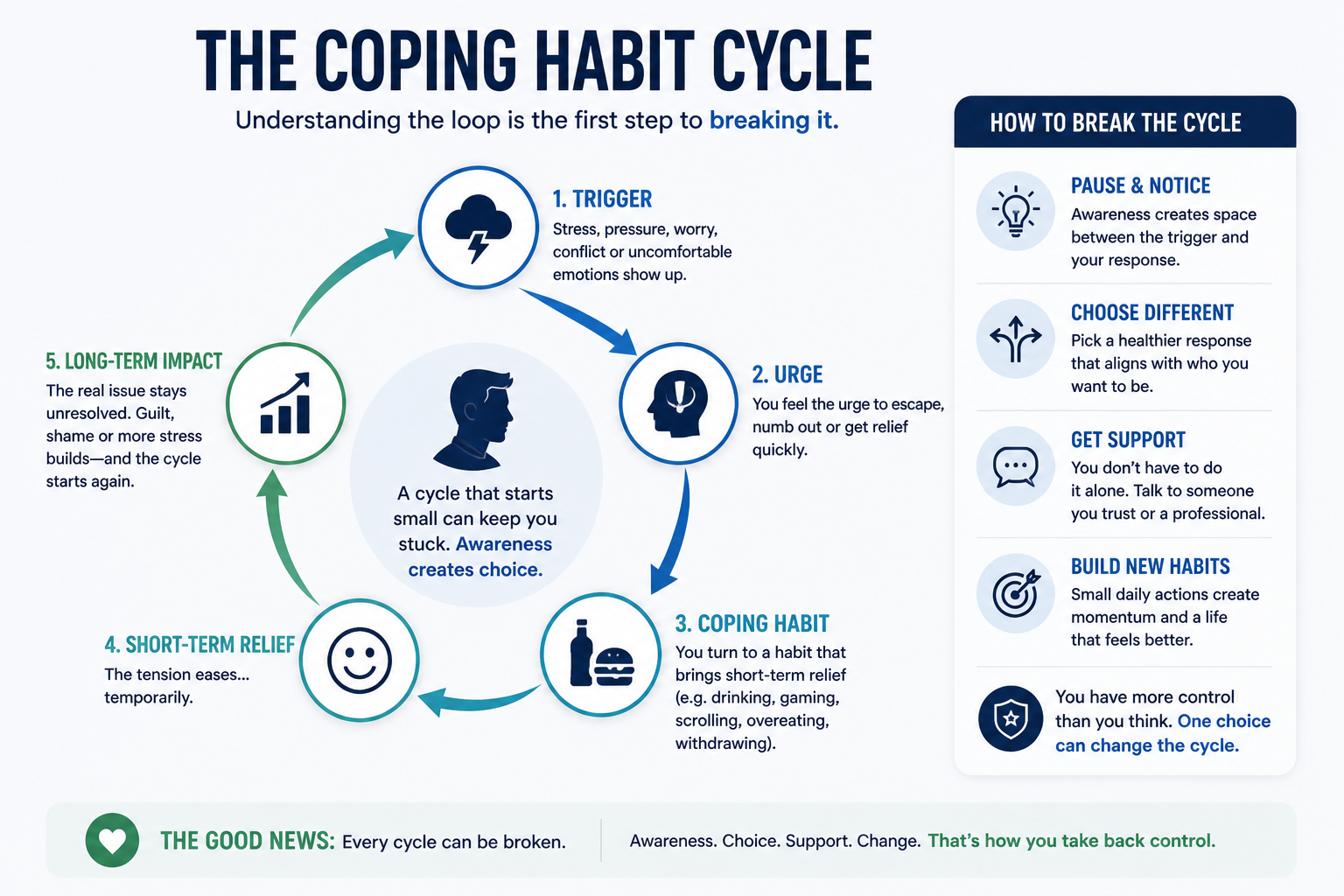
So the cycle repeats.
Stress builds.
You reach for relief.
You feel better for a while.
Then the consequences kick in.
Then you feel worse.
Then you need relief again.
That is the loop.
A coping habit becomes corrosive when it starts costing more than it gives back.
You might notice:
We have already written about this broader pattern in High-functioning stress: when coping becomes corrosive, where coping can look functional on the outside while quietly doing damage underneath. That article specifically names alcohol, porn, scrolling and work as common ways men try to switch their brain off.
Alcohol is one of the most socially accepted coping tools in Australia.
Had a hard day? Have a beer.
Big week? Get on it.
Feeling anxious? Take the edge off.
Can’t sleep? A couple of drinks might help.
The problem is that alcohol can blur the line between relaxation and reliance.
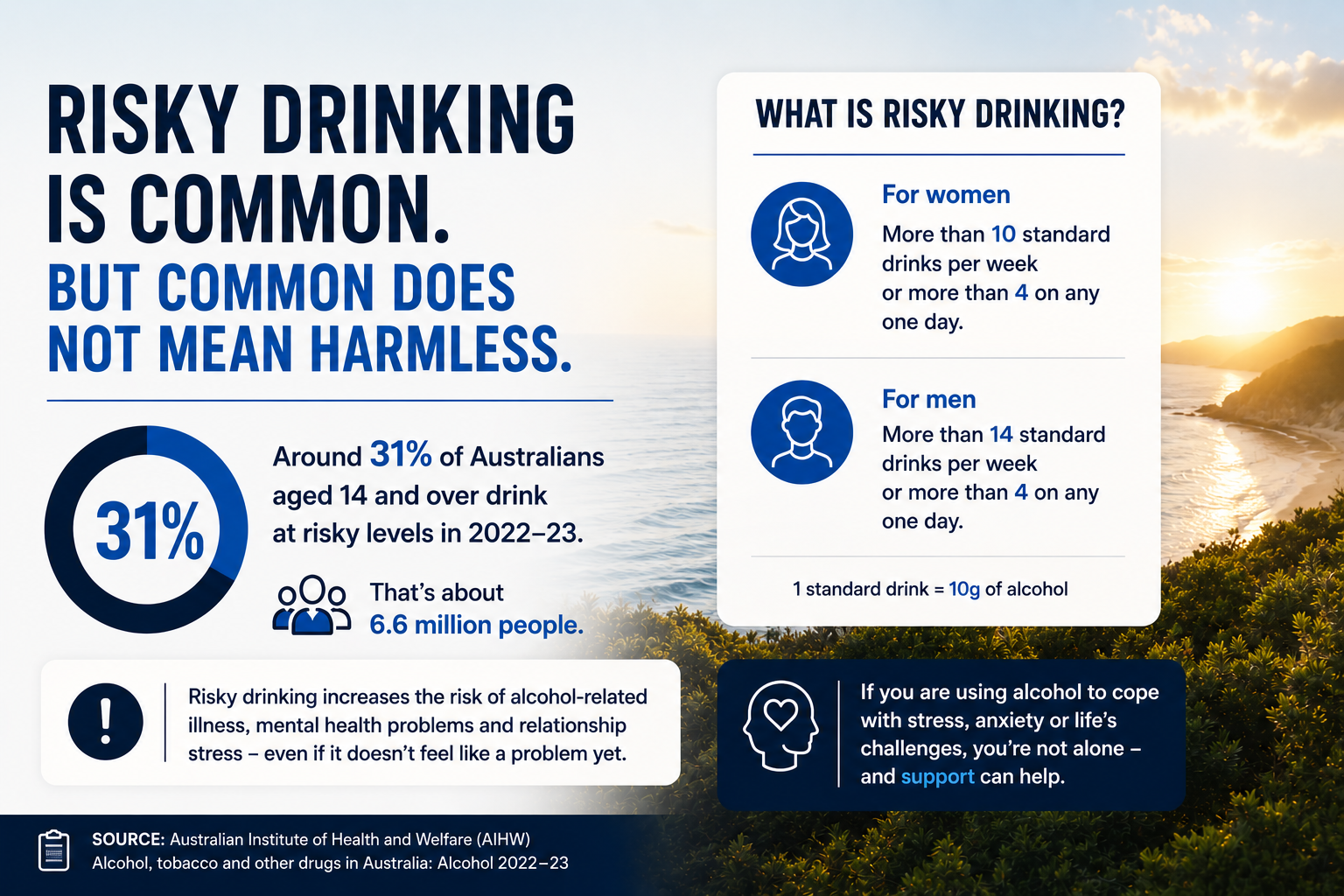
According to the Australian Institute of Health and Welfare, around 31% of Australians aged 14 and over, or about 6.6 million people, consumed alcohol at risky levels in 2022–2023 under the adult risk guidelines.
That does not mean every person drinking above the guideline has an alcohol problem. But it does show how normalised risky drinking has become.
Stress drinking is when alcohol becomes your go-to response to pressure.
It might sound like:
Again, the issue is not one drink. The issue is dependency on the pattern.
If alcohol is the only reliable way you relax, sleep, calm down, open up or feel less anxious, it is not just a drink anymore. It is doing a job.
And that job needs to be looked at properly.
Binge drinking can also feed anxiety.
A man might drink heavily to escape stress, then wake up with:
Then he pushes through the week, gets stressed again, and repeats the same pattern.
This is how binge drinking anxiety can become a cycle: alcohol is used to reduce pressure, but the aftermath creates more pressure.
Gambling is not just about money.
For some men, gambling becomes a way to escape feeling stuck.
It offers risk, reward, hope, intensity and distraction. It can create a hit of excitement when life feels flat, controlled or disappointing.
That is why gambling stress is so dangerous. The man is not always chasing money. Sometimes he is chasing relief, control, stimulation or a break from his own head.
The Australian Institute of Health and Welfare reports that gambling at risky levels increased between 2018 and 2022, with high-risk gambling rising from 1.1% to 1.8%. In 2022, high-risk gambling was reported by 2.4% of men, compared with 1.2% of women.
The Australian Institute of Family Studies also notes that Australians collectively lose around $32 billion each year on legal forms of gambling, describing Australia as having the largest per capita gambling losses in the world.
Gambling may be moving from entertainment into a coping issue if:
Online betting has made this worse because there is less friction. No pub, club or TAB needed. Just a phone, a trigger and a few taps.
That makes gambling feel private, quick and manageable, until it is not.
Porn is harder to talk about because it carries shame, judgement and defensiveness.
So let’s keep this grounded.
This is not about pretending every man who watches porn has a problem. That would be nonsense.
The issue is when porn becomes the main way a man manages stress, loneliness, rejection, boredom, anxiety, emotional discomfort or relationship disconnection.
Online pornography is highly present in young people’s online worlds, and eSafety research found many young people encounter pornography unintentionally during everyday internet use. The same research notes that young people identify possible negative impacts on consent, intimate relationships, sexual expectations and gender stereotypes.
"Our Watch" has also reported that 84% of surveyed participants agreed porn pushes stereotypes of what is expected of men and women in sex, while 79% agreed it impacts how women are viewed in real life.
For adult men, the issue often shows up differently.
Porn may be becoming a coping problem if:
The real issue is not just porn. It is what porn is helping you avoid.
Sometimes that is loneliness.
Sometimes it is resentment.
Sometimes it is sexual anxiety.
Sometimes it is shame.
Sometimes it is a relationship that has gone cold.
Sometimes it is just a man who does not know how to sit with uncomfortable emotion.
That is workable. But only if you stop pretending the habit is random.
Scrolling is the easiest one to dismiss.
“It’s just my phone.”
“Everyone does it.”
“I’m just relaxing.”
“I’m not doing anything wrong.”
True. But endless scrolling can still become a coping habit.
Beyond Blue notes that social media can have both positive and negative impacts on mental health, but it can also take people away from physical activity, sleep and face-to-face connection. It also identifies endless scrolling as something platforms are built to encourage through attention-grabbing algorithms.
Doomscrolling is not always about interest. Sometimes it is avoidance.
You are not actually enjoying it.
You are not learning much.
You are not resting.
You are just not dealing with the thing underneath.
Scrolling can become the modern version of emotional anaesthetic.
It fills silence.
It delays conversations.
It numbs boredom.
It distracts from anxiety.
It gives your brain tiny hits of novelty without requiring effort.
The problem is that you can spend an hour scrolling and still feel unrested.
Actually, worse than unrested. You can feel agitated, behind, distracted and annoyed with yourself.
Scrolling may be becoming a problem if:
eSafety’s research into young men online found that the internet can be a place where young men seek connection, validation and guidance, but also that harmful content and communities can appeal by meeting needs for validation, guidance, edginess and belonging.
That is relevant for adult men too.
The screen is rarely just the screen. It is often filling a gap.
A lot of men do not recognise coping habits early because they are still functioning.
They are working.
Paying bills.
Showing up.
Keeping things moving.
So they tell themselves it cannot be that bad.
But functioning is not the same as being well.
Plenty of men are functioning while:
This is where men get into trouble. They wait until something breaks before they take the pattern seriously.
The better move is to catch it earlier.
Not every coping habit is an addiction.
That matters.
Using the word addiction too early can make some men defensive, ashamed or less likely to seek help. But ignoring the pattern is not smart either.
A simple way to think about it:
You do it regularly, but you can choose not to. It does not cause major harm.
You still have some control, but the behaviour is starting to cost you. Mood, money, sleep, relationship, honesty or self-respect are being affected.
You feel pulled toward it even when you know it is hurting you. You struggle to stop, hide it, escalate it or organise life around it.
You do not need to wait until it is severe to get support.
In fact, earlier is better.
Do not start with a dramatic life overhaul. Most men fail there because they try to change everything at once.
Start smaller and more honestly.
Instead of:
“I’m just relaxing.”
Try:
“I’m using this to avoid stress.”
Instead of:
“It’s just a punt.”
Try:
“I gamble more when I feel flat or angry.”
Instead of:
“Everyone drinks.”
Try:
“I’m drinking because I don’t know how else to switch off.”
The truth gives you leverage.
For one week, write down what happened before the habit.
Look for patterns:
The trigger is usually where the real work starts.
Make the habit harder to access.
Examples:
Friction is not weakness. It is smart design.
You cannot just remove relief and leave a hole.
Try replacing the habit with something that actually regulates your system:
You are not trying to become perfect. You are trying to stop handing your stress to habits that quietly make life worse.
Counselling is not just for breakdowns.
It can help you work out:
At Man Counsellor, the first session is focused on clarity, practical tools and understanding what needs to change first not dragging people into endless therapy. The first session is about what is happening now, what feels stuck, what has already been tried and what needs to be different.
You can also read: What to Expect in Your First Session.
Counselling may be worth considering if:
If the issue has emotional weight, a mental health edge, or keeps showing up in your relationships and behaviour, counselling is usually a better fit than generic coaching. Man Counsellor’s article on Counselling vs Coaching explains this difference clearly.
No. The issue is not always the behaviour itself. The issue is the role it plays. If it becomes your main way to manage stress, loneliness, anxiety, boredom or conflict, it may be becoming a coping problem.
Stress drinking is when alcohol becomes a regular way to switch off, calm down, sleep, avoid feelings or cope with pressure. It can look normal on the outside but still become harmful over time.
Yes. Many men drink to reduce stress, but heavy drinking can contribute to poor sleep, guilt, irritability, low mood and increased anxiety afterwards. That can create a cycle where alcohol temporarily relieves anxiety but then adds to it later.
Gambling can create distraction, excitement, hope and a sense of control. For some men, it becomes less about money and more about escaping stress, boredom, anger or feeling stuck.
Some men experience compulsive porn use that feels difficult to control and causes distress or relationship problems. Whether someone calls it addiction, compulsion or avoidance, the important question is whether the behaviour is causing harm and becoming hard to stop.
Doomscrolling is not a diagnosis, but it can become a coping habit. If scrolling affects sleep, mood, attention, motivation or connection, it is worth taking seriously.
Get help when the habit is affecting your mood, relationship, money, sleep, work, honesty or self-respect, especially if you have tried to stop and keep falling back into the same pattern.
The coping habit is usually not the real enemy.
It is the signal.
Alcohol, gambling, porn and scrolling often show up when something underneath needs attention. Stress. Loneliness. Shame. Anger. Pressure. Disconnection. Boredom. Anxiety. A life that looks functional but does not feel right.
You do not need to wait until everything falls apart.
If the habit is starting to cost you, pay attention now.
Not with panic. Not with shame. Just honesty.
Because once you can see the pattern clearly, you can start changing it.