---
title: Why Men Lose Confidence When They Lose Their Sense of Self
description: Confidence is not just about achievement, discipline or performance. For many men, confidence starts with identity, belonging and knowing who they are.
image: https://blog.mancounsellor.com.au/hubfs/man-counsellor-confidence-sense-of-self-feature-image-1.png
---
Phil Armstrong
# Why Men Lose Confidence When They Lose Their Sense of Self
| ## Key Summary - Confidence is not only built through success, discipline, money, fitness or status. - A man’s confidence is closely tied to identity, belonging, values and self-knowledge. - When a man loses connection to who he is, where he belongs or what he stands for, confidence can quietly erode. - This can show up as anger, shutdown, anxiety, low motivation, relationship strain, overworking or feeling disconnected. - Counselling can help men make sense of what shaped them, rebuild confidence and move forward with more clarity. |
| --- |
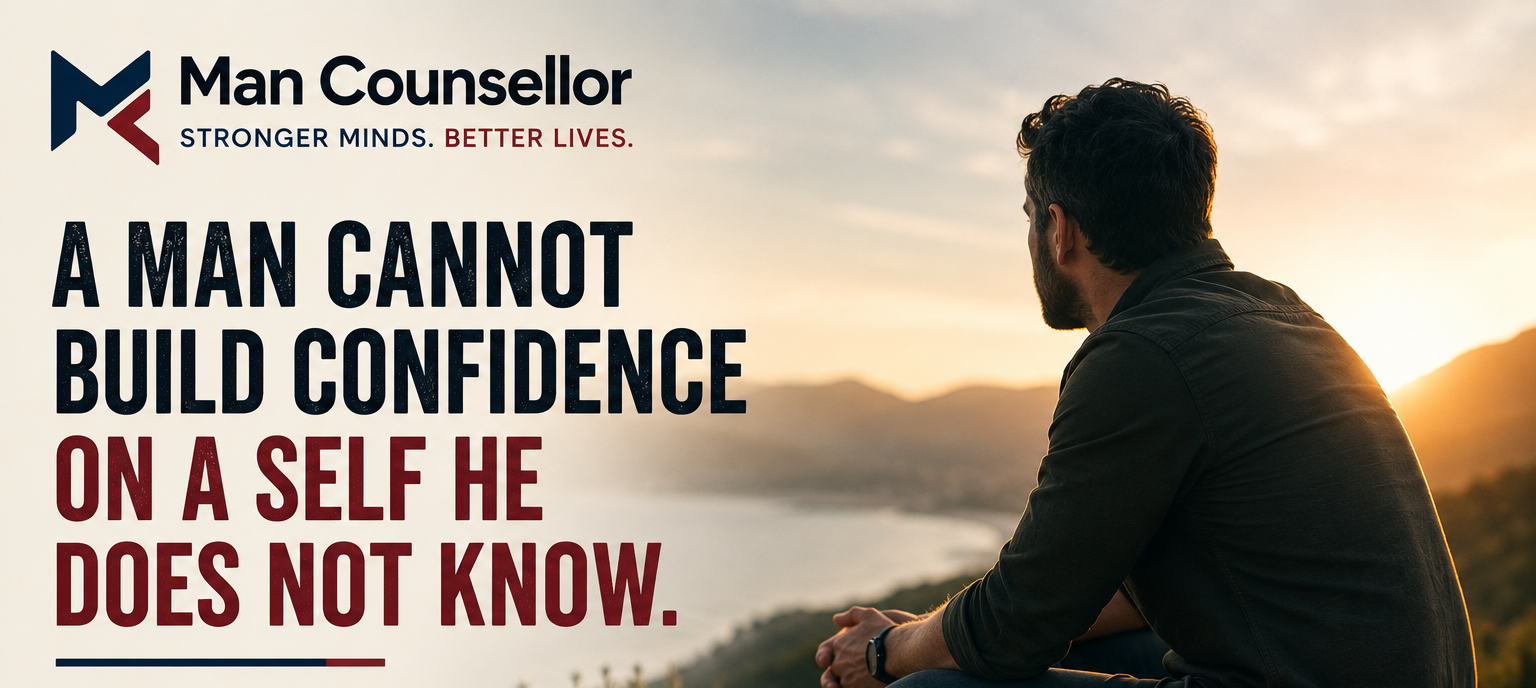
## A Man Cannot Build Confidence on a Self He Does Not Know
Losing culture is not just about losing language, tradition or history.
It can also mean losing connection to the things that once helped a man understand who he was, where he belonged and what he was supposed to stand for.
For some men, that culture is family.
For others, it is work, country, community, sport, faith, service, trade, fatherhood, military life, FIFO life, rural upbringing, or the quiet rules they were raised under.
When that connection is broken, dismissed, stripped away or slowly lost, something deeper can happen.
A man can lose confidence in himself without fully understanding why.
He may still function. He may still work, provide, perform and keep moving. From the outside, he might look fine.
But underneath, there can be a sense of deprivation. A feeling that something important is missing, even if he cannot name it properly.
Because confidence does not come only from achievement.
It comes from knowing who you are.
And when a man does not know who he is, every part of life can start to feel harder than it needs to be.
## Confidence Is Not Always About Ability
When people talk about confidence, they often make it sound like a performance problem.
Stand taller.
Speak better.
Get fitter.
Earn more.
Be more disciplined.
Stop doubting yourself.
There is nothing wrong with discipline, health, ambition or competence. They matter.
But they are not the whole picture.
Plenty of capable men lose confidence.
Men who can run businesses.
Men who can lead crews.
Men who can raise families.
Men who can fix problems for everyone else.
Men who can stay calm in a crisis but fall apart quietly when life slows down.
That kind of confidence loss is not always about skill.
Sometimes it is about identity.
A man can be competent and still feel lost. He can be productive and still feel empty. He can be respected by others and still not know how to respect himself.
That is the part many men miss.
They try to solve a deeper identity issue with surface-level performance.
More work. More gym. More money. More control. More alcohol. More scrolling. More avoidance. More pretending everything is fine.
Sometimes the issue is not that he needs to become tougher.
Sometimes the issue is that he has lost touch with himself.
If that sounds familiar, it also connects with a pattern we covered in [Why Men Shut Down Instead of Talking](https://blog.mancounsellor.com.au/why-men-shut-down-instead-of-talking). Shutdown is not always laziness, arrogance or emotional weakness. Sometimes it is what happens when a man no longer has words for what is happening inside him.
## What “Identity” Actually Means for Men
Identity can sound like a soft or abstract word, but it is practical.
Your identity is the answer to questions like:
- Who am I?
- What do I stand for?
- Where do I belong?
- What shaped me?
- What matters to me?
- What kind of man am I trying to be?
- What am I carrying that is not really mine?
- What parts of myself have I buried to survive, fit in or keep the peace?
For men, identity can come from many places.
It can come from family, work, values, culture, fatherhood, community, mateship, sport, trade, service, faith, country, responsibility, hardship, achievement, failure, grief, and the way a man was taught to see himself growing up.
Some men inherit a strong identity. Not perfect, but strong enough to stand on.
Others inherit confusion.
They grow up with mixed messages.
Be tough, but not aggressive.
Provide, but do not complain.
Be successful, but do not ask for help.
Be emotionally available, but do not be weak.
Be a good man but no one clearly explains what that means.
So they build a version of themselves that works for survival.
The reliable worker.
The funny bloke.
The fixer.
The hard man.
The provider.
The quiet one.
The high achiever.
The one who never needs anything.
That version might work for a while.
But it can become a cage.
## Culture Is Broader Than Ethnicity
When we talk about culture, people often think only of ethnicity, language or tradition. Those things matter deeply but culture is broader than that.
Culture is the environment that teaches a man what is normal.
It is the family culture he grew up in.
It is the work culture that shaped him.
It is the sporting culture that taught him how to compete, belong or hide pain.
It is the FIFO culture that taught him to switch off feelings and keep pushing.
It is the military, mining, trade, rural, religious, working-class, corporate or community culture that helped define what strength looked like.
Culture tells men what gets rewarded.
It also tells men what gets punished.
In some cultures, anger is acceptable but sadness is not.
Work ethic is praised but exhaustion is ignored.
Providing is respected but needing support is judged.
Silence is mistaken for control.
Emotional shutdown is mistaken for maturity.
When a man becomes disconnected from the culture that grounded him, or trapped inside a culture that no longer fits him, his confidence can take a hit.
Not always loudly.
Often quietly.
He just starts to feel less like himself.
## What Happens When a Man Loses His Sense of Self?
A man who has lost connection with himself may not say, “I am struggling with identity.”
He is more likely to say something like:
- “I do not know what is wrong with me.”
- “I have lost my confidence.”
- “I feel flat.”
- “I am angry all the time.”
- “I cannot switch off.”
- “I do not enjoy much anymore.”
- “I feel like I am just going through the motions.”
- “I do not know who I am outside of work.”
- “I am not the man I used to be.”
- “I should be happy, but I am not.”
This is where men often get stuck.
Because if the problem looks like anger, they try to control anger.
If it looks like stress, they try to manage stress.
If it looks like low motivation, they try to force discipline.
If it looks like relationship strain, they argue about the surface issue.
But underneath, there may be a deeper question:
**Who am I now?**
That question can hit men after divorce, fatherhood, grief, job loss, retirement, injury, financial stress, burnout, relocation, trauma, ageing, or simply years of living in a role that no longer fits.
A man can spend years being useful to everyone else and still have no idea what he actually needs.
That is not weakness.
That is disconnection.
## Low Confidence Can Look Different in Men
Low confidence in men does not always look like obvious insecurity.
It can look like overworking.
It can look like controlling everything.
It can look like anger.
It can look like avoiding hard conversations.
It can look like joking everything away.
It can look like shutting down.
It can look like drinking too much, scrolling too much, gambling, porn, isolation, or constantly needing distraction.
It can look like refusing help because needing help feels like failure.
Healthdirect notes that low self-esteem can be linked with insecurity, anxiety, shame, anger, relationship difficulty, low motivation and using alcohol or drugs to cope. That is important because many men do not recognise low self-esteem as low self-esteem. They just notice the fallout.
This is also why confidence cannot be rebuilt through hype alone.
A man does not need a motivational quote slapped over a mountain.
He needs to understand what is actually going on.
## Why Self-Knowledge Affects Performance
A man cannot live with confidence if he does not know who he is.
That does not mean he needs to have every answer. No one does.
But he does need some kind of internal compass.
Without that, life becomes reactive.
He says yes when he should say no.
He explodes when he should speak clearly.
He withdraws when he should stay connected.
He chases approval from people he does not even respect.
He keeps performing roles that are slowly costing him.
He confuses being needed with being valued.
He mistakes pressure for purpose.
This affects work, relationships, parenting, friendships, sex, health, money and decision-making.
A man with no clear sense of self is easier to push around by guilt, fear, shame, anger, ego, lust, money, status or other people’s expectations.
That is not a moral failure.
It is what happens when a man has not had the space, support or language to properly understand himself.
This links closely with the pressure many men feel to keep producing even when they are mentally cooked. We explored that in [Productivity, Pressure & Being a Man](https://blog.mancounsellor.com.au/productivity-pressure-being-a-man), where the issue is not just output. It is what happens to a man’s mind and relationships when performance becomes his whole identity.
## Belonging Matters More Than Men Admit
A lot of men underestimate how much belonging affects them.
They might say they do not need people.
They might say they are better on their own.
They might say they are not interested in talking about feelings.
Sometimes that is true.
Sometimes it is armour.
Belonging does not mean being surrounded by people all the time. It does not mean being popular or emotionally exposed with everyone.
It means having some place, person, role, group, value or purpose where a man does not feel like he has to constantly prove his right to exist.
That matters.
When men lose belonging, they often lose grounding.
This can happen when friendships fade, work becomes the only identity, family relationships fracture, a marriage ends, children grow up, a man leaves a familiar community, or the role he built his life around no longer gives him the same meaning.
Isolation can then become normal.
And once isolation becomes normal, confidence often drops with it.
Not because the man is weak.
Because humans are not built to carry everything alone forever.
## Counselling Is Not About Turning Men Into Someone Else
Some men avoid counselling because they think it means being analysed, softened, judged or turned into someone they are not.
Good counselling should not do that.
Counselling should not strip a man of his edge, humour, standards, values, bluntness or strength.
It should help him understand himself more clearly.
At [Man Counsellor](https://mancounsellor.com.au/), the goal is not to drag men into endless emotional excavation for the sake of it. The goal is practical progress.
That can include:
- understanding what has shaped your confidence
- naming what you have been carrying
- identifying patterns that keep repeating
- rebuilding self-respect through action
- improving communication without losing your backbone
- dealing with anger, shutdown, anxiety or shame more honestly
- separating who you are from what happened to you
- working out what kind of man you actually want to be now
For some men, the first breakthrough is not dramatic.
It is simple.
They finally say out loud:
“I do not think I know who I am anymore.”
That is not the end of confidence.
That can be the start of rebuilding it properly.
If you are unsure what counselling actually involves, this guide may help: [What to Expect in Your First Session & Prepare for Meaningful Progress](https://blog.mancounsellor.com.au/what-to-expect-in-your-first-session-and-how-to-prepare-for-meaningful-progress).
## Rebuilding Confidence Starts With Honesty
Confidence is not pretending.
It is not puffing your chest out while everything underneath is falling apart.
Real confidence is built when a man becomes more honest about who he is, what he values, what hurts, what needs to change, and what he is no longer willing to keep carrying.
That does not mean blaming everyone else.
It does not mean becoming fragile.
It does not mean sitting in victimhood.
It means telling the truth properly.
A man might need to ask:
- What parts of me have I abandoned?
- What did I learn about being a man that no longer serves me?
- Where am I performing instead of living?
- What role am I stuck in?
- What do I actually value now?
- Who do I become under pressure?
- What am I avoiding?
- What would self-respect look like in this situation?
- What do I need to stop pretending is fine?
These are not soft questions.
They are hard ones.
Because it is often easier to keep grinding than to stop and admit you do not feel like yourself anymore.
## You Do Not Need to Have a Crisis to Get Support
A man does not need to wait until everything collapses before getting help.
You do not need to be at rock bottom.
You do not need to have the perfect words.
You do not need to know whether it is anxiety, depression, burnout, identity, grief, anger or stress.
You can start with something blunt:
“I do not feel like myself.”
“I have lost confidence.”
“I am functioning, but I am not right.”
“I keep reacting in ways I do not like.”
“I do not know what is going on, but something has shifted.”
That is enough.
Counselling can help turn that vague internal mess into something clearer, more workable and less isolating.
## Final Thoughts
A man cannot build confidence on a self he does not know.
That does not mean he needs to have his whole life perfectly worked out. No one does.
But if a man is disconnected from his identity, values, culture, belonging or sense of self, confidence becomes shaky. He might still perform. He might still function. He might still look fine from the outside.
But inside, he can feel lost.
That loss of self can show up as anger, shutdown, low motivation, anxiety, relationship strain, overworking, avoidance or a quiet sense that life has become heavier than it should be.
The answer is not fake hype.
It is not pretending to be bulletproof.
It is not chasing another version of success that still leaves you empty.
The work starts with honesty.
Who are you?
What shaped you?
What have you lost connection with?
What do you stand for now?
What kind of man are you trying to become?
A man does not need to become perfect.
He needs to become more honest with himself.
That is where real confidence starts.
## FAQ
### Why do men lose confidence?
Men can lose confidence for many reasons, including relationship problems, work stress, financial pressure, grief, trauma, ageing, health issues, isolation, failure, burnout or major life changes. For some men, confidence drops when they lose connection with their identity, values, culture, role or sense of belonging.
### Can losing your sense of self affect mental health?
Yes. A weak or unclear sense of self can affect confidence, relationships, decision-making, mood and coping. It can also make a man more vulnerable to anxiety, shame, anger, avoidance and unhealthy coping habits.
### What does identity mean for men?
Identity is a man’s understanding of who he is, what matters to him, where he belongs, what has shaped him and what kind of man he wants to be. It can be influenced by family, culture, work, fatherhood, community, values, faith, sport, trade, hardship and lived experience.
### Is culture only about ethnicity?
No. Ethnicity, language and tradition are important parts of culture, but culture is broader. Men can also be shaped by family culture, work culture, FIFO culture, military culture, sporting culture, rural culture, trade culture, religious culture and community culture.
### How does low confidence show up in men?
Low confidence in men may show up as anger, withdrawal, overworking, people-pleasing, avoidance, jealousy, emotional shutdown, low motivation, relationship strain, substance use, gambling, excessive scrolling or constantly needing distraction.
### Can counselling help men rebuild confidence?
Counselling can help men understand what has affected their confidence, identify patterns, rebuild self-respect, improve communication and reconnect with their values. It is not about turning men into someone else. It is about helping them understand themselves more clearly and move forward with practical support.
### Do I need to know what is wrong before seeing a counsellor?
No. Many men start counselling with a simple statement like, “I do not feel like myself,” or “I have lost confidence.” You do not need the perfect words before getting support.
## References
Australian Bureau of Statistics. (2023). **National Study of Mental Health and Wellbeing, 2020–2022.**
[https://www.abs.gov.au/statistics/health/mental-health/national-study-mental-health-and-wellbeing/latest-release](https://www.abs.gov.au/statistics/health/mental-health/national-study-mental-health-and-wellbeing/latest-release)
Australian Institute of Health and Welfare. **Prevalence and impact of mental illness.**
[https://www.aihw.gov.au/mental-health/overview/prevalence-and-impact-of-mental-illness](https://www.aihw.gov.au/mental-health/overview/prevalence-and-impact-of-mental-illness)
Australian Research Alliance for Children and Youth. (2019). **A Positive Sense of Identity and Culture.**
[https://www.aracy.org.au/wp-content/uploads/2024/09/Full_report_-_A_Positive_Sense_of_Identity_and_Culture.pdf](https://www.aracy.org.au/wp-content/uploads/2024/09/Full_report_-_A_Positive_Sense_of_Identity_and_Culture.pdf)
Beyond Blue. **Men’s mental health.**
[https://www.beyondblue.org.au/mental-health/mens-mental-health](https://www.beyondblue.org.au/mental-health/mens-mental-health)
Healthdirect Australia. **Self-esteem and mental health.**
[https://www.healthdirect.gov.au/self-esteem](https://www.healthdirect.gov.au/self-esteem)
Healthdirect Australia. **Mental health resources for men.**
[https://www.healthdirect.gov.au/mens-mental-health](https://www.healthdirect.gov.au/mens-mental-health)
Allen, K. A., et al. (2021). **Belonging: A Review of Conceptual Issues, an Integrative Framework, and Directions for Future Research.** Australian Journal of Psychology.
[https://pmc.ncbi.nlm.nih.gov/articles/PMC8095671/](https://pmc.ncbi.nlm.nih.gov/articles/PMC8095671/)
Shepherd, G., et al. (2023). **The challenges preventing men from seeking counselling or psychotherapy.**
[https://www.sciencedirect.com/science/article/pii/S2212657023000296](https://www.sciencedirect.com/science/article/pii/S2212657023000296)
Headspace. **Your cultural identity and mental health and wellbeing.**
[https://headspace.org.au/explore-topics/for-young-people/cultural-identity-mental-health/](https://headspace.org.au/explore-topics/for-young-people/cultural-identity-mental-health/)
[ ](https://blog.mancounsellor.com.au/hs/cta/wi/redirect?encryptedPayload=AVxigLLL4USBlZtTMaR%2FWX5%2FoNngNBOeLN4CZJZteZoT60j%2BUpjApHxjstbFw0gST9CY6P6A0WjramTQHbMWW6wyKsxFkuU7mE6ND0d3PdbGJBRDHyGd83vo%2FuZNUBSmLpqxPH1KCr9zjcnJ4T1gVbBZH1cA6y5TFWvLugi1x3X6Vn0X%2FjIa3XTM81gCoU2z2wsJ0VlcsnS2jJ1kTA%3D%3D&webInteractiveContentId=261528638924&portalId=442234355)
[mailto:https%3A%2F%2Fblog.mancounsellor.com.au%2Fwhy-men-lose-confidence-when-they-lose-their-sense-of-self](mailto:https%3A%2F%2Fblog.mancounsellor.com.au%2Fwhy-men-lose-confidence-when-they-lose-their-sense-of-self)
## Keep reading
[
Phil Armstrong
### How Men Can Access Relationship Counselling in Australia
](https://blog.mancounsellor.com.au/how-men-can-access-relationship-counselling-in-australia)
[
Phil Armstrong
### Supporting Men Does Not Mean Excusing Violence
](https://blog.mancounsellor.com.au/supporting-men-does-not-mean-excusing-violence)
```json
{
"@context" : "https://schema.org",
"@type" : "BlogPosting",
"author" : {
"@type" : "Person",
"name" : "Man Counsellor",
"url" : "https://blog.mancounsellor.com.au/author/man-counsellor"
},
"dateModified" : "2026-06-03T21:30:00.611Z",
"datePublished" : "2026-06-03T21:30:00.000Z",
"headline" : "Why Men Lose Confidence When They Lose Their Sense of Self",
"image" : [ "https://blog.mancounsellor.com.au/hubfs/man-counsellor-confidence-sense-of-self-feature-image-1.png" ],
"mainEntityOfPage" : {
"@id" : "https://blog.mancounsellor.com.au/why-men-lose-confidence-when-they-lose-their-sense-of-self",
"@type" : "WebPage"
},
"publisher" : {
"@type" : "Organization",
"logo" : {
"@type" : "ImageObject",
"url" : "https://blog.mancounsellor.com.au/hubfs/Man-counsellor-concept-2-scaled-removebg-preview.png"
},
"name" : "Man Counsellor"
}
}
```