---
title: "\"Looksmaxxing\" Is Not Confidence. It’s a Trap"
description: Looksmaxxing can look like self-improvement, but the hidden cost is teaching boys that self-worth is a score and masculinity is something to perform.
image: https://blog.mancounsellor.com.au/hubfs/looksmaxxing%20blog-1-1.png
---
# "Looksmaxxing" Is Not Confidence. It’s a Trap
There is nothing wrong with wanting to look better.
Most men understand that. Have a shower. Get a haircut. Train hard. Wear clothes that fit. Look after your skin. Stand up straight. Take some pride in yourself. None of that is the problem.
The problem starts when self-improvement quietly turns into self-surveillance.
That is where looksmaxxing becomes more than a trend.
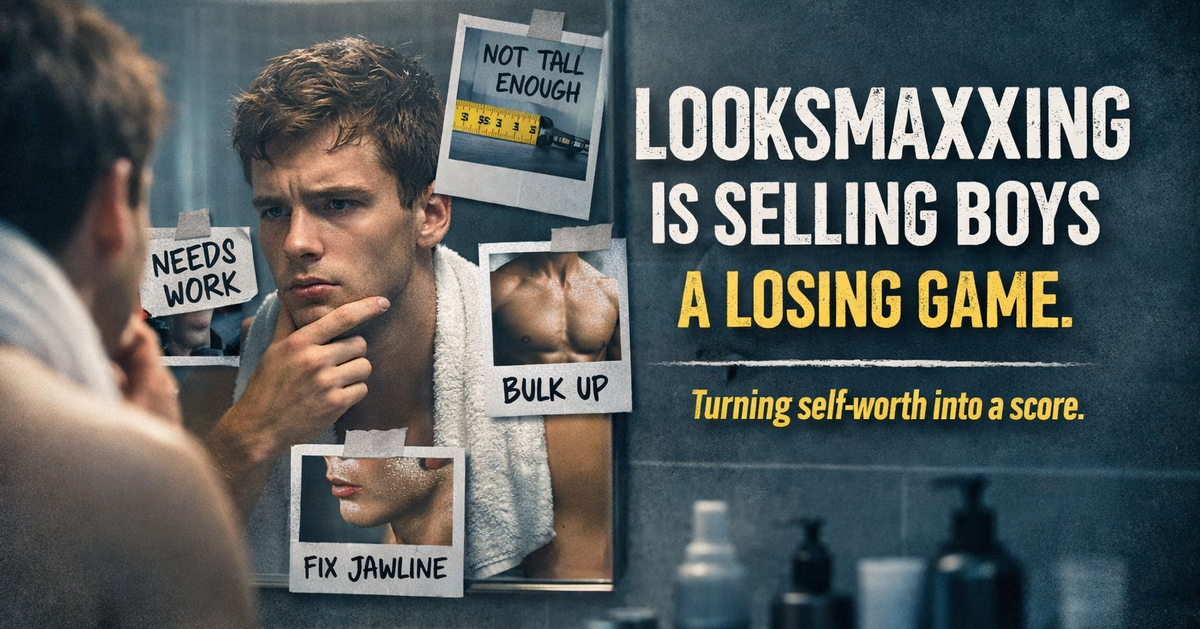
On the surface, looksmaxxing gets packaged as discipline, confidence and optimisation. Improve your jawline. Improve your body. Improve your face. Improve your chances. It sounds like motivation. It sounds like control. It sounds like a young bloke trying to get his act together.
But underneath it, there is often a much uglier message: your worth is measurable, your body is a problem to solve, and if you are not getting the outcomes you want, you probably do not look good enough.
That is a dangerous lesson for boys and young men to absorb.
---
### **When Self-Improvement Stops Being Healthy**
A 2025 study examining a major looksmaxxing forum found the culture was built around relentless appearance-based critique, pressure to change the body through interventions ranging from “mewing” to surgery, and what the researchers called “masculine demoralisation” where users were treated like failed men if they did not meet a narrow physical ideal. The researchers concluded that looksmaxxing communities can harm the physical and mental health of the men and boys involved.
That is the hidden cost of this path.
It is not just vanity.
It is not just teenage insecurity with a new label.
It is the way a normal human vulnerability gets turned into a full-time ranking system.
A boy starts out wanting to look better. Fair enough. But if he spends enough time in the wrong corners of the internet, that simple desire gets hijacked. Soon he is not just trying to be healthier or more confident. He is learning to inspect himself like a product. Face shape. Height. Body fat. Hairline. Skin. Eye area. Jaw. Status. Sexual market value. Suddenly he is not a person anymore. He is a project under hostile review.
That is not confidence.
That is anxiety wearing a gym shirt.
---
### Why It Lands So Easily
Boys are growing up in an environment where this stuff lands easily. Butterfly Foundation’s 2024 BodyKind Youth Survey found body dissatisfaction remains common among young Australians. In the young male snapshot, 83.6% of male respondents said they wanted to be more muscular, 64.0% wanted to be taller, 65.0% reported receiving negative comments or teasing about their appearance, and 22.8% said social media made them feel dissatisfied with their body.
So when looksmaxxing shows up promising answers, it is not entering neutral territory. It is stepping into a gap that already exists.
Looksmaxxing often gets mistaken for harmless self-care. Grooming tips. Fitness advice. Better presentation. But there is a line between looking after yourself and building your identity around external ratings.
Once a young man starts believing his value depends on how well he performs masculinity online, he is on shaky ground.
That is where self-improvement can quietly become self-rejection.
---
### When the Algorithm Gets Involved
Research from the University of South Australia linked social networking site activity in young men with muscle dysmorphia risk, showing that likes, comments and appearance-focused engagement can feed obsessive concern about muscularity and body image.
So the issue is not simply that boys care about how they look. Boys have always cared. Men have always cared, even if many were taught to pretend otherwise.
The issue is that the digital environment now monetises male insecurity.
It rewards comparison.
It rewards obsession.
It rewards the feeling of never quite being enough.
And because this content often sits inside broader “men and masculinity” influencer culture, looksmaxxing is not just about appearance. It can also carry messages about status, women, dominance, hierarchy and what counts as being a “real man”. Movember’s recent research found that 68% of young Australian men reported engaging with one or more men and masculinity influencers, and among those who engaged, risky and obsessive health behaviours were more common, including steroid use or considering testosterone injections.
That does not mean every young bloke watching self-improvement content is headed off a cliff.
But it does mean we should stop pretending this is only about skincare, haircuts and the gym.
---
### What Boys Are Really Looking For
For some boys, looksmaxxing is filling a need.
It offers structure.
It offers answers.
It offers a sense of control in a world where a lot of young men feel unsure of themselves.
That is part of why it spreads.
Not because boys are stupid.
Not because they are vain.
Because insecurity mixed with algorithms is a brutal combination.
And if adults are honest, many boys are not being given enough spaces to talk plainly about body image, confidence, rejection, masculinity and self-worth without either being mocked for it or sold something.
So the answer is not to laugh at them.
It is not to dismiss them with lazy lines about vanity.
It is to speak honestly.
---
### A Better Message for Boys and Men
Looking after yourself is good.
Training hard is good.
Taking pride in your appearance is fine.
But if your self-worth lives and dies by what the mirror says, what the camera says, what strangers online say, or whether you look enough like some algorithm-approved version of masculinity, you are building your identity on sand.
A stronger version of masculinity is not built on constant self-measurement.
It is built on steadiness.
Character.
Self-respect.
Competence.
Humour.
Restraint.
Relationships.
The ability to be uncomfortable without turning yourself into a problem that always needs fixing.
---
### What We Should Be Paying Attention To
This is where the conversation needs to go deeper than appearance.
If a boy becomes obsessed with fixing his face, his body or his image, the real question is not just what he is doing. It is what he has come to believe.
What has he learned about worth?
What has he learned about being a man?
What has he learned about what makes him acceptable?
Because if the answer is that he must constantly improve to deserve respect, attention or love, then the problem is no longer grooming or fitness or self-care.
The problem is that he has started to build his identity around conditional worth.
And that is a brutal foundation to hand to a young man.
---
### **The Hidden Cost**
Boys do not need more pressure to become visually perfect.
They need a wider definition of what makes them worth something.
Because the real danger in looksmaxxing is not that it teaches boys to care about their appearance.
It is that it can teach them that appearance is where their value begins and ends.
And that is a losing game.
---
## **References**
Halpin, M., Maguire, M., & Giesbrecht, C. (2025). *When help is harm: Health, lookism and self-improvement in the manosphere*. Sociology of Health & Illness.
Donnarumma, L., Hogue, J. V., Campagna, J., Griffiths, S., Lim, M. S. C., & Mitchison, D. (2025). *An investigation of the relationship between social networking site activities and muscle dysmorphia in young men*. *New Media & Society*. University of South Australia summary and DOI listing.
Butterfly Foundation. (2025). *BodyKind Youth Survey 2024: Young males snapshot* and national snapshot.
Movember Institute of Men’s Health. (2025). *Young men’s health in a digital world*.
eSafety Commissioner. (2025). *Supporting young men online*.
[ ](https://blog.mancounsellor.com.au/hs/cta/wi/redirect?encryptedPayload=AVxigLLeruBp9LjxetfVWPksUkvgeHp2P6m0luK2ODQyNFOJhJnzn2%2FpyiCQtD%2BAnliIwakCOTxAFpuJsHbhVTEneUvOoQ0NN%2Fa5EZBJuWUw58RKqpjdasyv3qpAQ0XKJmOOEEup0VFolcOz%2BoQBPVJBCIlszKIch%2BT5uSqrzM7w%2B4lJ73bsNf%2BbAd9BqJM1CJQbgYzCZ%2FxxmnKNJg%3D%3D&webInteractiveContentId=261528638924&portalId=442234355)
[mailto:https%3A%2F%2Fblog.mancounsellor.com.au%2Flooksmaxxing-is-selling-boys-a-losing-game](mailto:https%3A%2F%2Fblog.mancounsellor.com.au%2Flooksmaxxing-is-selling-boys-a-losing-game)
## Keep reading
[
Phil Armstrong
### How Men Can Access Relationship Counselling in Australia
](https://blog.mancounsellor.com.au/how-men-can-access-relationship-counselling-in-australia)
[
Phil Armstrong
### Supporting Men Does Not Mean Excusing Violence
](https://blog.mancounsellor.com.au/supporting-men-does-not-mean-excusing-violence)
```json
{
"@context" : "https://schema.org",
"@type" : "BlogPosting",
"author" : {
"@type" : "Person",
"name" : "Man Counsellor",
"url" : "https://blog.mancounsellor.com.au/author/man-counsellor"
},
"dateModified" : "2026-03-17T21:00:00.340Z",
"datePublished" : "2026-03-17T21:00:00.000Z",
"headline" : "\"Looksmaxxing\" Is Not Confidence. It’s a Trap",
"image" : [ "https://blog.mancounsellor.com.au/hubfs/looksmaxxing%20blog-1-1.png" ],
"mainEntityOfPage" : {
"@id" : "https://blog.mancounsellor.com.au/looksmaxxing-is-selling-boys-a-losing-game",
"@type" : "WebPage"
},
"publisher" : {
"@type" : "Organization",
"logo" : {
"@type" : "ImageObject",
"url" : "https://blog.mancounsellor.com.au/hubfs/Man-counsellor-concept-2-scaled-removebg-preview.png"
},
"name" : "Man Counsellor"
}
}
```